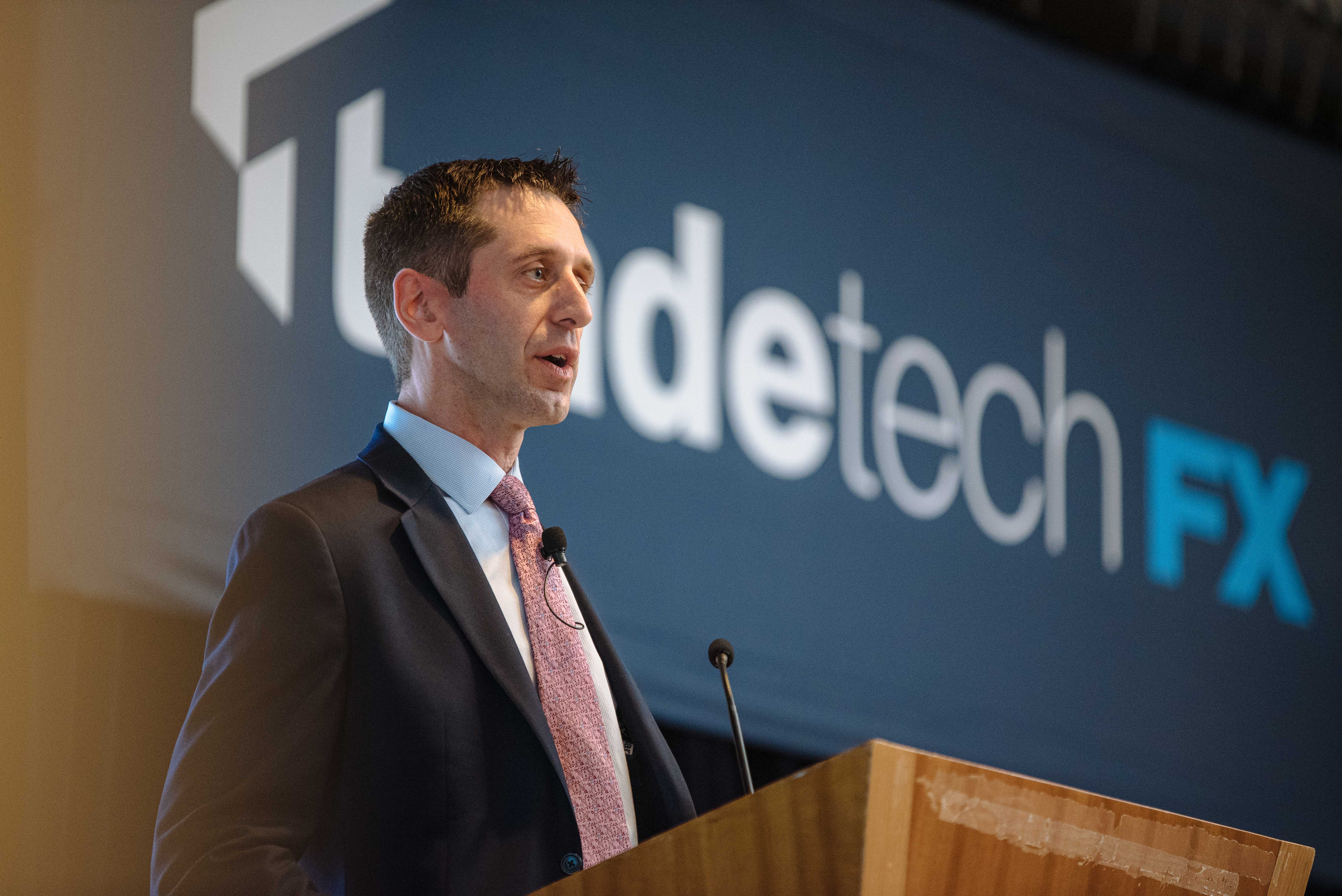
This is another segment from our Fixed Income Trading 2012 event on January 24th. My panel discusses the impact of the Volcker rule on the credit market – the market likely to be the hardest hit by the proposed new rule.
Here’s the first snippit of the panel I moderated at our Fixed Income Trading event on January 24th. Both Citi and BAML discuss the increases in electronic swaps trading that they’ve seen on the CDS desk in the past year. We’re not even close to the electronic market that Dodd-Frank will ultimately mandate, but it is clear that the move to the screen has already begun (albeit slowly).
If Congress really had its way (well, the Democrats anyway) than all swaps would have been forced to look and trade like futures.
If you’re reading this blog than you know that would be a classic square peg, round hole. Case in point: Eurex launched iTraxx futures some years back and no liquidity every developed. But times have changed, and although I’m not completely convinced the world needs credit-default swap (CDS) futures, the upside if the contracts are successful is big enough that it is nearly inevitable that they will come to market ahead of CDS trading and clearing mandates later in 2012. Why?
Firstly clearinghouse margin requirements for CDS are seen by many as unnecessarily high. Complications related to clearing sovereign and bank CDS, two of the most highly used CDS segments, will leave margin requirements for those products even higher than for index CDS. These high margin requirements alone could open the door for CDS futures as the margin requirements for futures are tracking much lower than for comparable swaps.
Hence my comments to Dow Jones. CDS futures won’t take off just because the market wants to take directional bets on credit, they’ll take off because they provide an economic incentive to those wanting to take direction bets on credit:
Kevin McPartland, principal at the independent research firm TABB Group, said these so-called “liquidity” issues would drive more trading in CDS and “that would only translate to demand for CDS futures” so long as they offered some economic benefits over the existing swap contract.
A dealer working on the CDX futures project said it could be a solution that would drive volumes because the contracts could be traded in smaller sizes than CDS, and this could appeal to investors not currently trading in swaps. “It’s something that makes sense,” he said.
Over the last few weeks the topic of CDS futures has come up a bit in my conversations with industry participants. In fact we discussed this back stage at our recent Fixed Income Trading 2012 event in New York on January 24th. Everyone seems convinced that several firms are “working on the problem”. However, a TABB Group estimated 80% of CDX.IG trading in the interdealer market happening electronically based on a highly standard contract (remember the Big Bang in 2009?) begs the question, with such a standard, relatively liquid market already in place why do we even need a future? Its nothing more than a different regulatory rubber stamp calling the product one thing over another.
It can even be argued that margin rates for cleared CDS and the comparable cleared CDS future should be the same. If they’re economically equivalent than why wouldn’t margin requirements be equivalent? That point leads to another discussion that I’ll come back to in the coming months.
The bottom line – someone will bring CDX.IG futures to market, but betting on their success is purely a game of chance. Only time will tell.
Read the full story at WSJ.com
I recently spoke with Rashad Kurbanov who is a Managing Director at consulting firm Investance in NY. We had an interesting discussion about how the credit markets might evolve in the coming months, with corporate bonds impacting CDS liquidity and vice versa. This is a topic I will continue to dig into in great detail in the coming months via my research at TABB Group. Until then:
I was lucky enough to get a demo of this platform a few weeks ago. Its very impressive, and a sign of things to come in fixed income. Not just for cash markets, but for automated market making in the swaps market as well. I suspect we’ll see similiar product announcements from competing forms in the not too distant future.
—-
NEW YORK, Jan. 31, 2012 /PRNewswire via COMTEX/ — Credit Suisse is proud to introduce Credit Suisse Onyx Streaming, a new way of trading Cash U.S. Treasury securities which offers clients the ability to i
nstantly trade on live, transparent and executable two-way streaming markets, all with a single click of a mouse. Onyx Streaming is a significant step forward in electronic trade execution for U.S. Treasuries that reflects many of the advances seen in other electronic markets such as equities, futures and foreign exchange.
Traditionally, electronic trading of U.S. Treasuries between dealers and clients has been executed using Request-For-Quote (RFQ) protocols in which clients manually request a one-sided price and wait for responses from one or more dealers. While RFQ is appropriate for many types of trades, Onyx Streaming is a dynamic new tool for traders looking for quick, decisive transactions. With Streaming, clients choose from a range of maturities, enter a size, and instantaneously see an executable two-sided market over Credit Suisse’s award-wining PrimeTrade platform.
“Onyx Streaming is another example of Credit Suisse’s commitment to giving clients access to liquidity using highly innovative technologies,” says Jon Kinol, Global Head of Rates at Credit Suisse. “The fixed income markets are accelerating their shift toward electronic trading, and we are committed to leading the way.”
“The U.S. Treasury market is one of the most liquid in the world, which leaves us to wonder why clients have for so long been without the ability to trade electronically directly with a dealer on firm, continuously streaming prices, as is common in the interdealer market. Continued volatility in the global economy has made direct access to firm prices all the more critical, and innovations in trading technology make that possible,” says Kevin McPartland, Principal and Director of Fixed Income Research at TABB Group, a financial markets research and strategic advisory firm.
Streaming U.S. Treasury trading further solidifies the position of Credit Suisse Onyx as the market’s leading fixed income trading platform for interest rate products, offering innovative algorithmic trading, outright cash Treasury trading, and access to Clearwater, the bank’s immense aggregated pool of liquidity.
“Looking at other markets such as FX has shown us that many clients prefer to trade in ways other than RFQ when they value transparency, certainty, and speed of execution,” says Ryan Sheftel, Head of Electronic Market Making for Global Rates at Credit Suisse. “We offer our clients a full spectrum of trading capabilities so that they always have access to the most advanced solutions that fit their needs.”
Credit Suisse Onyx is a key element of Credit Suisse PLUS, the bank’s innovative source of client focused electronic solutions that span research, analytics and trading.
Credit Suisse
Credit Suisse is one of the world’s leading financial services providers and is part of the Credit Suisse group of companies (referred to here as ‘Credit Suisse’). As an integrated bank, Credit Suisse offers clients its combined expertise in the areas of private banking, investment banking and asset management. Credit Suisse provides advisory services, comprehensive solutions and innovative products to companies, institutional clients and high-net-worth private clients globally, as well as to retail clients in Switzerland. Credit Suisse is headquartered in Zurich and operates in over 50 countries worldwide. The group employs approximately 50,700 people. The registered shares (CSGN) of Credit Suisse’s parent company, Credit Suisse Group AG, are listed in Switzerland and, in the form of American Depositary Shares (CS), in New York. Further information about Credit Suisse can be found at www.credit-suisse.com .
SOURCE Credit Suisse AG
Copyright (C) 2012 PR Newswire. All rights reserved
On Tuesday, January 24th we held our Fixed Inco
me Trading 2012 event. Over 450 people attended to hear three panels, one armchair interview and an economist keynote which provided a someone positive picture for 2012.
Wall Street & Technology posted a good, quick recap of what was discussed at the event. We have also posted several behind the scenes interviews with the panelists and speakers.
My short intro at the event explains the tone of the afternoon:
When we gathered here a year ago, on January 26th to be precise,the CFTC had just proposed its final Dodd-Frank inspired rule.
Much of that afternoon was spent debating the pros and cons of the proposals and what the various rules would do to liquidity and competition amongst market participants.
If you recall, we ended the day expecting – well, maybe hoping, really – that by time we held our next TabbFORUM conference, that trading and clearing mandates would be in place and we could discuss how the market had changed.
That was then and this is now and that rather optimistic prediction unfortunately hasn’t come true.
However, I’m sure you’ll all agree, the fixed-income world has in fact changed quite a bit during the past 12 months.
– a few rules have actually been set in stone…
– Electronic trading in a few swaps products has taken off, finally…
– And according to some, the U.S. Government is no longer a risk-free investment.Our goal today is to not have a regulatory debate, but instead discuss what’s actually happening in the fixed-income market today, and how macro and micro events across the world’s landscape will impact how market participants trade, invest, innovate … and make money.
Over the next few weeks I’ll post some of the video from the day on Kevin on the Street and most of the event in some way, shape or form will be available on TabbFORUM, so keep an eye out.
Now that we have the 2012 event behind us, its time for me to get back to work. Thanks everyone who attended, sponsored and helped.
The FT published a great special section this past Monday on the state of OTC derivatives reform. Coverage ranged from the im
pact of MF Global on margin and segregation rules to technology innovation driven by the new rules. What these stories all reaffirm is how much the details of the final rules will impact liquidity, product selection, the growth of electronic trading and what set of tools will ultimatey be most valuable in helping market participants come out on top.
“As volatility alone can cause rapid intra-day deterioration of major counterparty credit quality, a move
towards near-time or realtime clearing is inevitable anyway,” said Kevin
McPartland, fixed income analyst at Tabb Group, in a report last year.…
“Some of the most contentious rule proposals are those that will impact
liquidity fragmentation the most,” says Kevin McPartland, [Principal] at Tabb Group.
The full feature is available at FT.com
January was a good month for corporate bonds. Investors are desperate for yield and the issuers want to be sure to take advantage of historically low
rates. Even though half the world is scared of banks, it seems even they can borrow money pretty cheaply these days. My favorite bond issue of January is SABMiller, because its always good when someone is investing in beer production.
But in all seriousness, while this is all good news its hard to feel confident that the mood will last. The market is fickle and often irrational lately – if Merkel says the wrong thing tomorrow this call all go in the other direction. But here’s to hoping this is all a sign of good things to come in 2012.
“Because the markets are very volatile, more than what happened a month ago or will happen a month from now, what matters is what’s happening right now,” Kevin McPartland, director of fixed-income research for financial markets research firm TABB Group said.
And there’s always the allure of an almost-free lunch. “Funding is cheap so there’s a lot of incentive to tap the markets now … even if they don’t have anything to do with the money,” McPartland said.
Read the full article at ibtimes.com
 Our 2012 Fixed Income Trading event is taking place on Tuesday January 24th. We have a great agenda for the afternoon that should shed some light on what the major players in the fixed income markets are thinking about liquidity, derivatives reform, the sovereign debt crisis and a whole host of other issues we’re currently facing. Here I talk to Greg Crawford about what you can expect from the event:


Who Needs Fiber Optics when you have Microwaves?
In 2010 I wrote about the value of shaving off microseconds on long distance routes for high speed trading strategies. Spread Networks proved that value by creating and selling its direct
link between NY and Chicago, cutting off roughly 3 milliseconds from the roundtrip.
I spend a lot of time looking at the maps back then, and can tell you there is virtually no more direct path between the two cities. I joked in the report that the only way to go more direct was a wire between the Empire State Building and the Sears Tower. Well, it seems McKay and Aviat are trying to do just that (albeit with slightly different end points), with microwaves.
Microwaves can in fact cut time off the round trip, but there are a lot of caveats. The bandwith of microwave is very low. It would be nearly impossible to send the entire OPRA feed in real-time for example. Microwave is also impacted by weather. Bad rain and snow could shut the communications down (it never snows in Chicago does it?).
Conversations I’ve had tell me that the better application for microwave is short term links – say Mahwah to Carteret. Even still, it seems the NY-Chicago route will come online and inevitably people will jump on board. Quite frankly I don’t think it will hurt Spread that much, but it does present an interesting new option. Apparently low latency isn’t dead.
Read the press release here